Launch Flow Inc.
Contact UsContact Us
Digital Intake and Consent for Virtual Care Providers Digital Intake and Consent for Virtual Care Providers
Digital Intake and Consent for Virtual Care Providers
Virtual Care · Patient Applications · EHR Integration

Telehealth Software Development for Virtual Care Providers

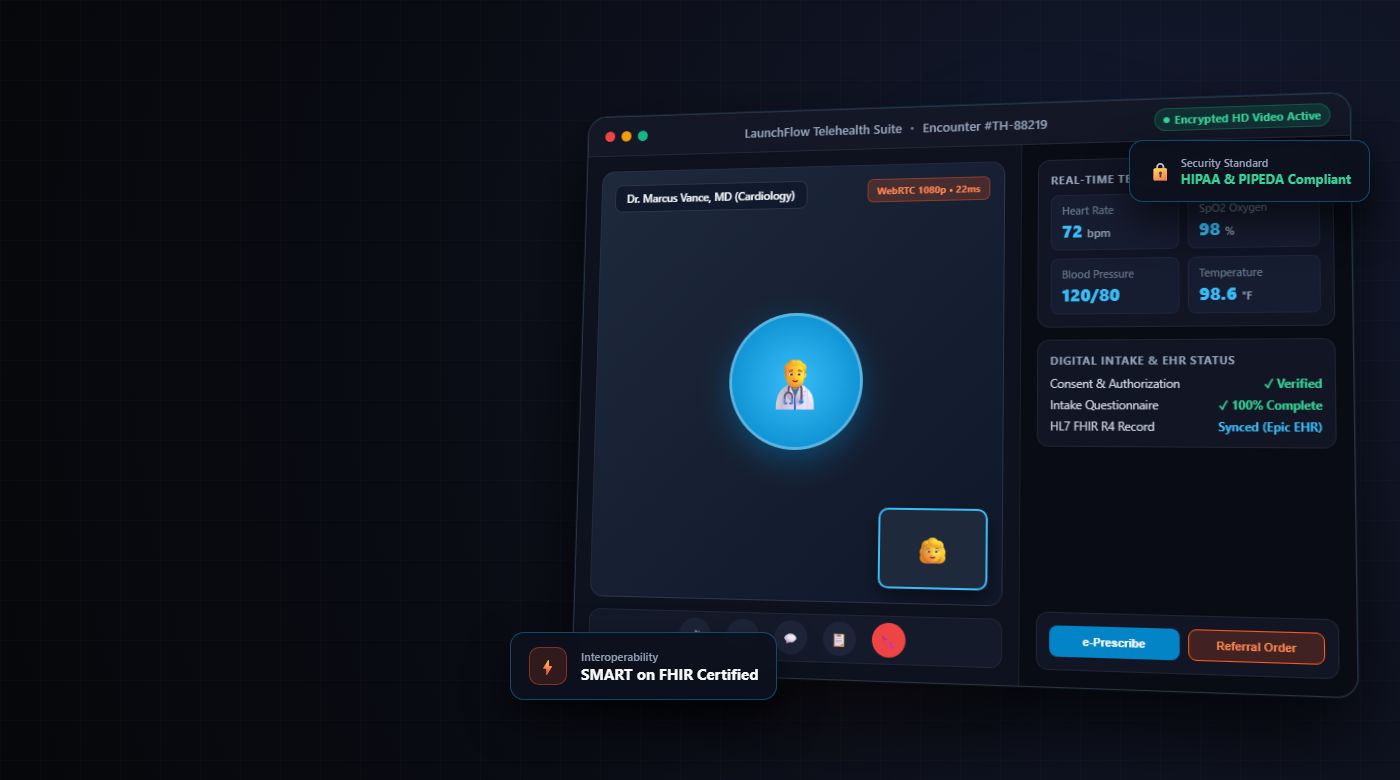
Launch Flow develops custom telehealth platforms for healthcare providers in Canada and the US. Connect patient intake, virtual visits, and follow-up with the scheduling and clinical systems your team already uses.

Client Reviews And Feedback

Google Rating 5.0 Clutch 5.0 Trustpilot GoodFirms
Healthcare provider network
Digital health practice
Health system network
Healthcare information platform
Healthcare solutions
Clinical services platform
Digital health practice
Integrated healthcare practice
Virtual Care Across Specialties

Custom Telehealth
Software for Different Care Settings

A recurring therapy appointment and a one-time specialist consultation need different booking, intake, and follow-up steps. Our healthcare software development team works with your staff to decide which steps to build, connect, or keep in existing systems.
Telehealth Care Settings
01Primary And Specialty Care
02Mental And Behavioral Health
03Home And Community Care
04Rehabilitation And Physical Therapy
05Diagnostic And Imaging Providers
06Digital Health And SaaS Businesses
01
Virtual Consultations And Follow-Up
01/06

Primary And Specialty Care

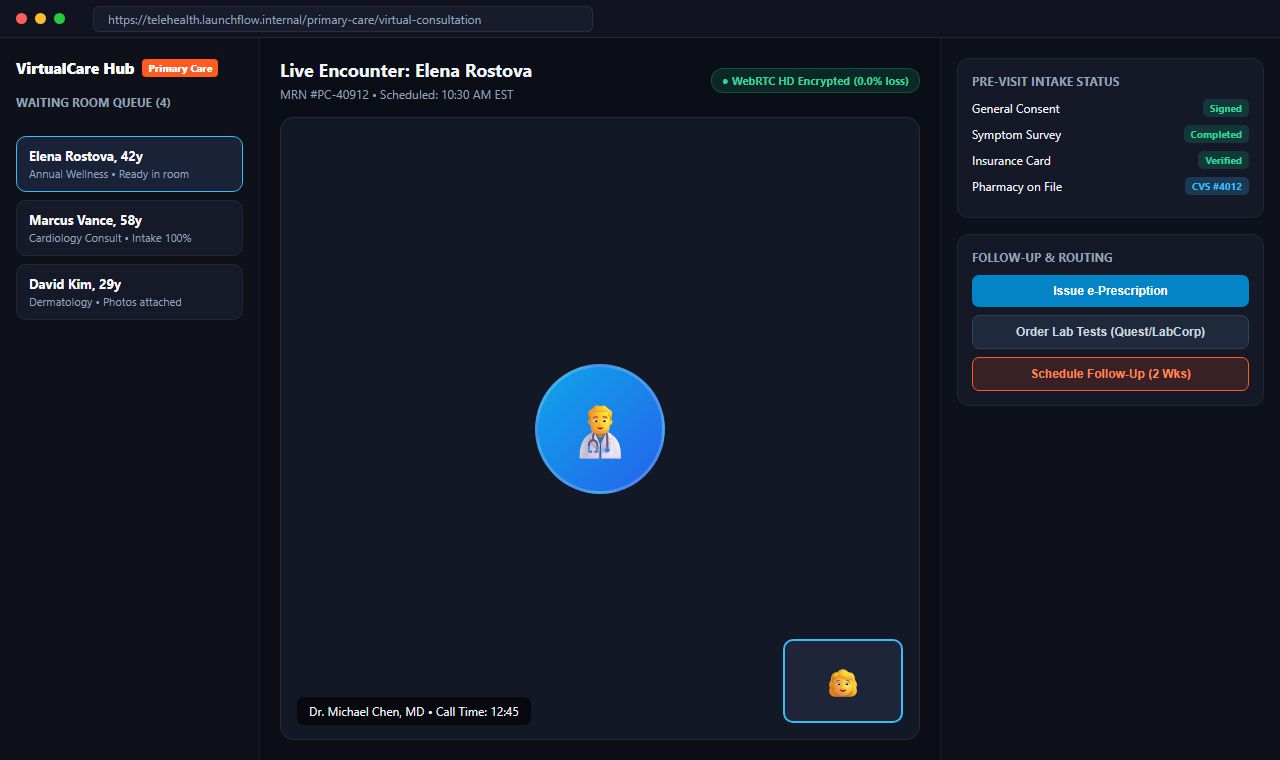
Connect appointment requests, pre-visit forms, and remote consultations so staff can see what’s ready before a patient joins. Route follow-up to the right team after the visit.
Virtual Consultations Visit Preparation Follow-Up
Primary And Specialty Care Software Interface
02
Therapy Intake And Recurring Sessions
02/06

Mental And Behavioral Health

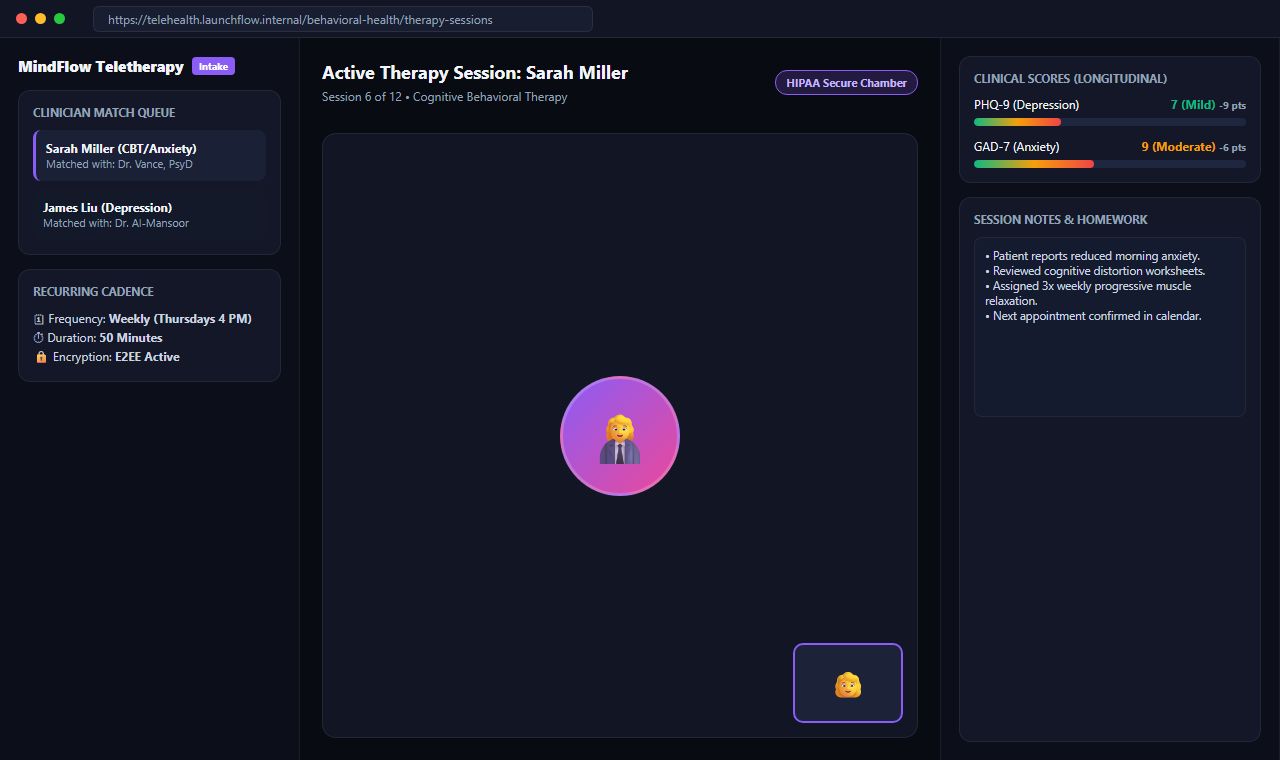
Give therapy teams a way to review referrals, match patients with available clinicians, and manage recurring sessions. Set access according to who needs to see each part of the intake.
Therapy Intake Clinician Matching Recurring Sessions
Mental And Behavioral Health Software Interface
03
Remote Check-Ins Between Visits
03/06

Home And Community Care

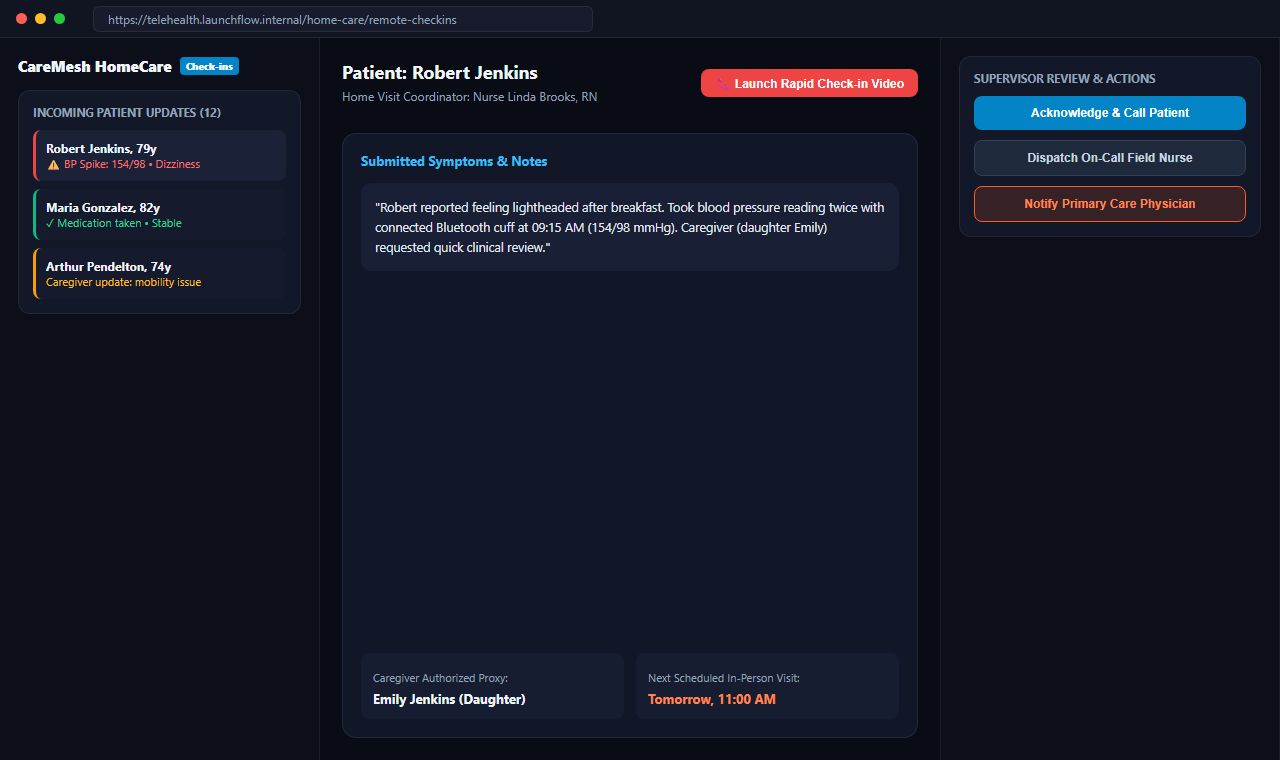
Collect updates from patients or authorized caregivers between in-person visits. Give coordinators a way to review submissions, assign follow-up, and see which requests are still open.
Remote Check-Ins Caregiver Access Staff Follow-Up
Home And Community Care Software Interface
04
Care Plans And Progress Review
04/06

Rehabilitation And Physical Therapy

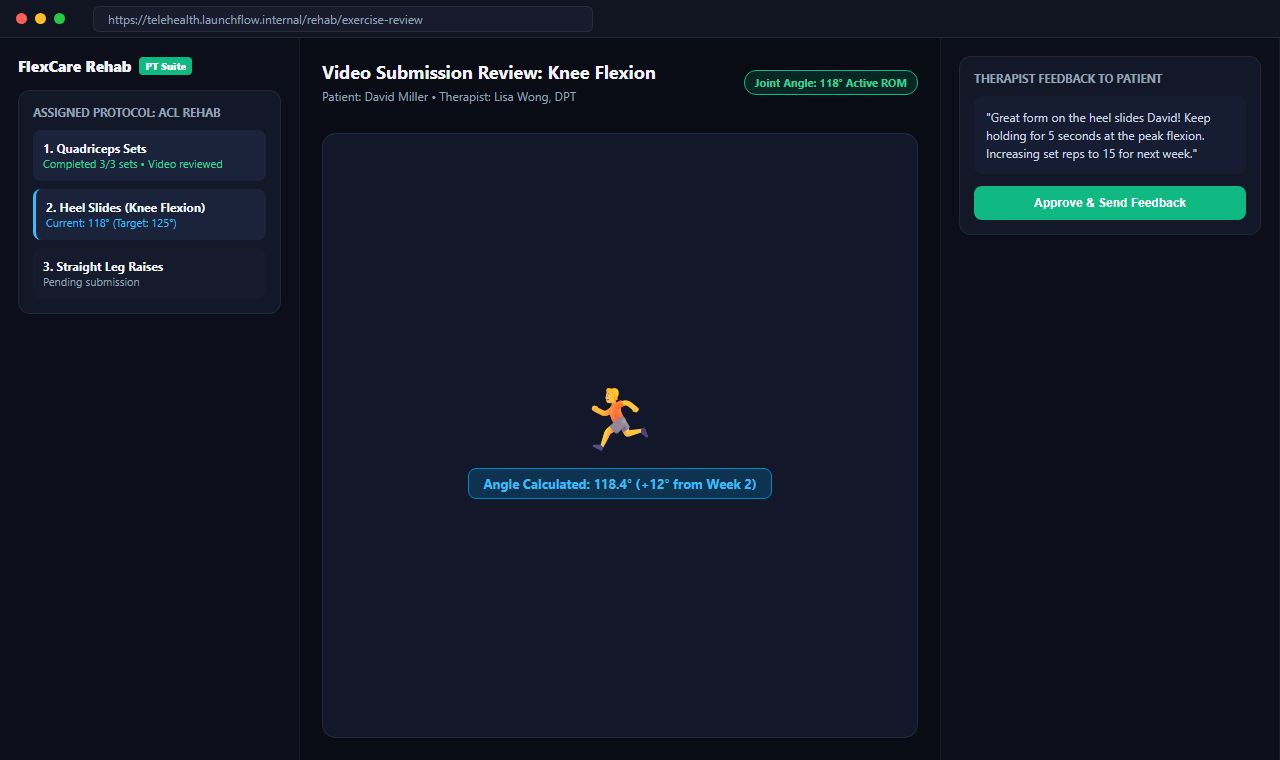
Let patients view assigned exercises and submit progress updates between sessions. Give therapists a place to review what came in and decide what to discuss at the next visit.
Exercise Plans Progress Updates Clinician Review
Rehabilitation And Physical Therapy Software Interface
05
Monitoring And Ongoing Review
05/06

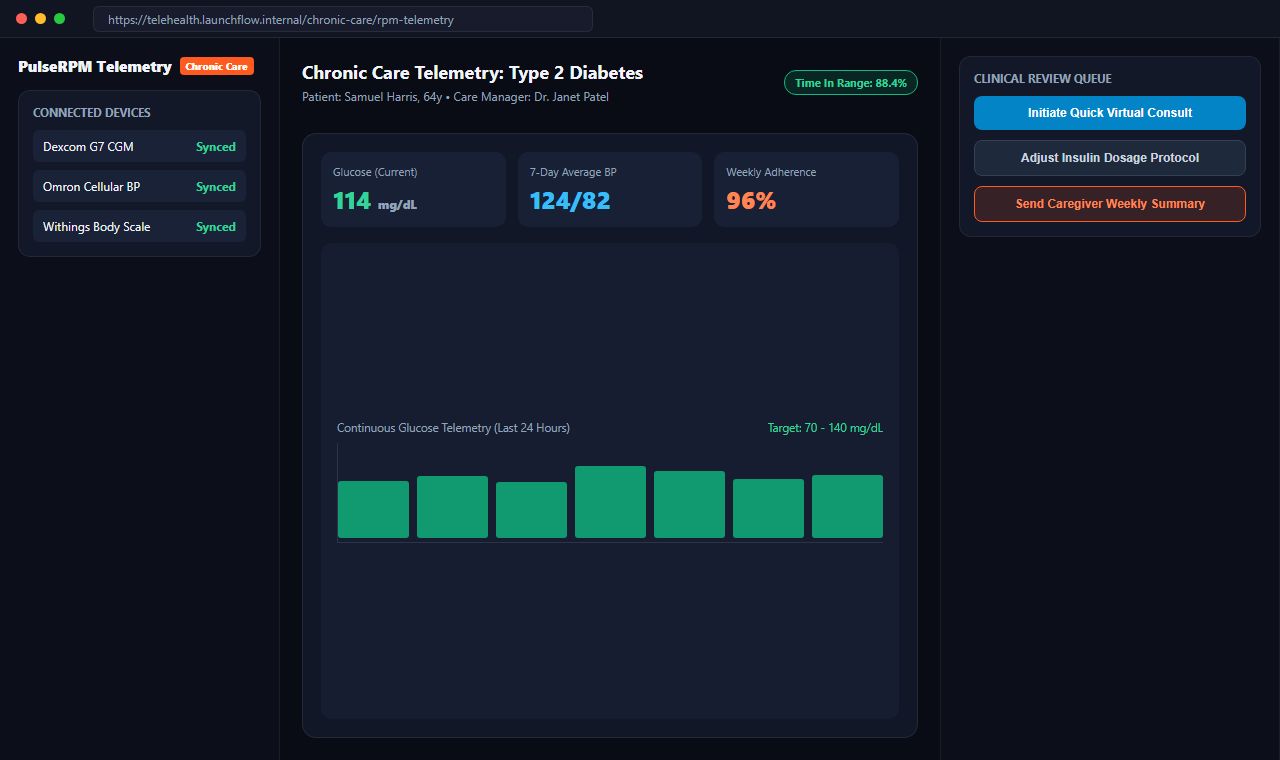
Chronic Care Programs

Collect questionnaires or readings from supported sources. Agree with your care team on who reviews incoming information and what staff do when a reading is missing.
Patient Check-Ins Device Integrations Review Queues
Diagnostic And Imaging Providers Software Interface
06
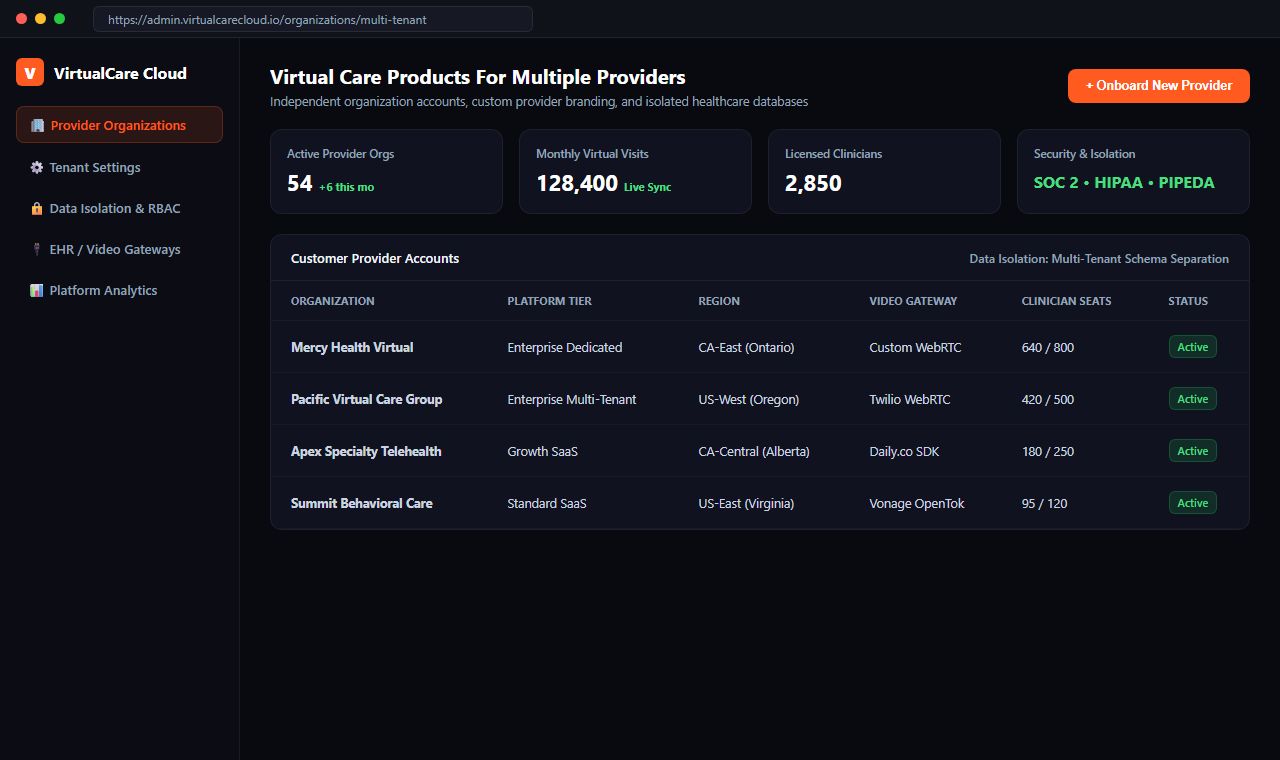
Virtual Care Products For Multiple Providers
06/06

Digital Health And SaaS Businesses

Build a virtual care product that independent organizations can operate with their own users, settings, and integrations. Plan how each customer is onboarded and how their data stays separate.
Organization Accounts Customer Settings Data Separation
Digital Health And SaaS Businesses Software Interface
Start With One Care Pathway
Define What Your Healthcare Software Needs To Improve

Show us where patients wait, staff repeat work, or a visit depends on disconnected tools. We’ll work through the steps with your team and identify what the first release needs to change.

Current Workflow Existing Systems First Release
What Should Your Telehealth Platform Improve First? What Should Your Telehealth Platform Improve First?
Patient Apps, Clinician Tools And Integrations

Telehealth Software Development Services From Discovery To Operation

Build a complete virtual care platform or improve one part of the experience. We scope the work around what patients need to do, what staff need to review, and which systems can support it.
Patient Applications & Care Workflows

Patient Access & Virtual Visits

Help patients book the right appointment, complete the required steps, and reach their provider. Give staff a way to help when a patient can’t complete a step online.

  • Online Appointment Booking

    Let patients request or book a visit according to provider availability and clinic rules. Show whether an appointment is confirmed or still needs staff approval.

  • Digital Intake and Consent

    Collect questionnaires, documents, and consent before a visit. Show staff what the patient has submitted and which items are still needed to proceed.

  • Virtual Waiting Rooms

    Give patients a place to check in and see what happens next. Let staff see who’s waiting and provide instructions when an appointment runs late.

  • Video and Audio Visits

    Connect an approved communications provider. Give patients a way to test their setup, join the appointment, or reconnect if the call drops.

  • Patient Accounts and Portal Access

    Provide a place for patients to view visit details, forms, and follow-up instructions, with account recovery and caregiver access considered where needed.

  • Reminders and Visit Instructions

    Send appointments and preparation instructions through approved channels. Keep sensitive visit details out of notifications where patients may see them on shared devices.

Practice Operations & Administration

Clinical Workflows & Follow-Up

Give clinicians and coordinators a way to prepare for appointments, review submissions, and track outstanding work. Each request should have a status and someone responsible for the next step.

  • Clinician Workspaces

    Show upcoming visits, available intake information, and outstanding tasks in a workspace that reflects what each clinician needs before and after an appointment.

  • Referral Review and Assignment

    Route referrals by service, location, or provider. Let coordinators request missing documents and see which patients are still waiting for a decision.

  • Asynchronous Care

    Collect questionnaires, photos, or updates for later review where appropriate. Show patients when submissions are checked and who to contact if they need help sooner.

  • Secure Patient Messaging

    Send messages to a queue that staff are assigned to monitor. Show patients the expected response time and which questions belong in that channel.

  • Care Plans and Follow-Up Tasks

    Prepare information for billing or downstream administration through validation and transfer rules, with receiving-system requirements and process ownership established before automating any part of the handoff.

  • Operational Reporting And Dashboards

    Surface operational measures that teams can act on, including queue lengths, submission delays and outstanding reviews, with definitions agreed before building reporting views.

AI, Integrations & Healthcare Data

EHR, Data & AI Integrations

Connect systems, structure data and introduce AI where there is a clear operational purpose. Every integration or automated step needs defined boundaries, fallback paths and staff review mechanisms where required.

  • Telehealth EHR and EMR Integration Services

    Connect applications with EHR and EMR systems through available interfaces, handling record matching, data mapping, service interruptions and retry procedures appropriately.

  • Healthcare API Development

    Build internal and partner APIs using healthcare data standards, with authentication, rate limiting and data validation suited to the organizations exchanging information.

  • LLM And Generative AI Healthcare Applications

    Develop AI-Assisted Workflows for drafting, summarization or information retrieval, with practitioner review, structured outputs and defined boundaries around system actions.

  • Document Intelligence And Data Extraction

    Extract structured information from incoming forms, referral documents or clinical summaries, with confidence checks and review queues for records that require staff verification.

  • Healthcare Data Pipelines

    Organize data movement between care applications, analytics systems and partner platforms, with validation, transformation rules and failure alerts planned around operational dependencies.

  • Audit Logging And Data Governance Tools

    Record user actions, system events and data access in structured audit logs, supporting compliance review, incident investigation and access governance requirements.

SaaS Development & Modernization

SaaS Development & Platform Operations

Build multi-tenant healthcare products and improve existing systems so organizations can operate them reliably. Architecture, security controls and deployment practices are planned around healthcare customer expectations.

  • Healthcare SaaS Product Development

    Build multi-tenant applications with organization accounts, role-based access, configurable workflows and customer administration designed into the product architecture from the start.

  • Location and Provider Configuration

    Migrate legacy applications to modern cloud infrastructure in stages, preserving existing data, essential workflows and integration points throughout the transition.

  • Healthcare Cloud Architecture

    Design and deploy cloud infrastructure on AWS, Azure or GCP with healthcare-appropriate security controls, network isolation, encryption and high-availability configurations.

  • Multi-Tenant Healthcare Architecture

    Partition tenant data and configure shared services so organizations maintain data isolation while benefiting from unified product updates and operational monitoring.

  • Microservices And API Modernization

    Refactor monolithic healthcare applications into modular services where independent scaling, deployment or team ownership justifies the architectural transition.

  • Software Maintenance And SLA Support

    Provide ongoing application monitoring, security patching, dependency updates and incident response under agreed service levels and operational response times.

Healthcare Work That Informs Virtual Care

Healthcare Software Work Across the Virtual Care Journey

Our healthcare projects include work on intake, appointment preparation, patient access, and staff coordination. These examples show what we delivered in those areas and how it relates to virtual care.

Primary Care Practice Hub

Practice Operations Software | Primary Care
The Software Need

The practice needed a more consistent way to coordinate patient registration and appointment-related work, with staff able to identify missing information and follow up on outstanding tasks.

What We Developed

Application workflows supporting registration, appointment coordination and staff review, with information organized around the actions the practice team needed to complete before and after a patient’s visit.

Delivered Features
  • Registration workflows with submission and review statuses.
  • Appointment-related tasks assigned to responsible staff.
  • A shared view of incomplete records and follow-up requirements.

Diagnostic & Imaging Center

Referral & Diagnostic Handoffs | Imaging Providers
The Software Need

Referral processing and appointment booking relied on manual handoffs across teams, with document checks and scheduling delays leading to repeated follow-up calls.

What We Developed

A referral coordination application that tracks receipt, document completeness and appointment scheduling across receiving departments and referring clinics.

Delivered Features
  • Referral intake queues with document verification checks.
  • Status updates visible to administrative and scheduling teams.
  • Automated notifications for missing records or incomplete submissions.

Hand In Hand Therapy Centre

Program Intake & Practitioner Workflows | Therapy Clinic
The Software Need

Managing program intake and therapist assignment across several therapy disciplines was handled through shared spreadsheets, creating scheduling conflicts and slow response times.

What We Developed

A program intake and coordination platform that supports family submissions, therapist assignment and progress tracking across multidisciplinary care plans.

Delivered Features
  • Program intake forms with structured assessment fields.
  • Therapist assignment workflows with caseload visibility.
  • Care plan milestone tracking and family communication records.

Physical Therapy Practice

Care Plans & Review Workflows | Physical Therapy
The Software Need

Patients lacked a structured way to access assigned home exercises and report completion, while clinicians spent substantial clinic time reviewing routine exercise adherence.

What We Developed

A patient companion application paired with a clinician review dashboard, supporting prescribed exercise plans, adherence logging and follow-up scheduling.

Delivered Features
  • Patient-facing exercise plans with video guidance and logging.
  • Clinician dashboard for adherence review and plan adjustments.
  • Secure messaging for technique questions and follow-up booking.

CareMesh Patient Portals

Patient Portal Application | Digital Health SaaS
The Software Need

A healthcare startup needed a white-label patient portal product that clinic customers could configure for their own branding, intake forms and scheduling workflows.

What We Developed

A multi-tenant patient portal SaaS platform with customizable clinic branding, modular intake workflows and secure bidirectional communication.

Delivered Features
  • White-label clinic portal with custom branding and domains.
  • Configurable intake and consent workflows per organization.
  • Encrypted patient-provider messaging and document sharing.

Specialty Medical Network

Multi-Clinic SaaS Application | Specialty Care
The Software Need

A network of specialty clinics needed centralized reporting and patient handoff coordination across twelve locations while maintaining location-specific autonomy.

What We Developed

An enterprise coordination platform linking location-specific operations with central network analytics, standardized intake protocols and resource scheduling.

Delivered Features
  • Centralized network dashboard with location-level permissions.
  • Standardized intake protocols and specialty referral routing.
  • Cross-location resource availability and specialist scheduling.
Modern Healthcare Software Engineering

Architecture, AI And Delivery Methods Behind
Your Healthcare Software

Modern techniques should address specific requirements. We select architecture, integration and deployment methods around the application’s users, information and operating responsibilities, with ways to test important decisions before release.

Product Thinking And Engineering Discipline

Why Choose Launch Flow for Telehealth Software Development

We consider the application, the people operating it and the systems around it together. That gives product development, SaaS architecture, AI integration and compliance-related work a shared scope with visible responsibilities.
(01)

A First Release With A Defined Purpose

We identify what the first users need to complete and which exceptions staff must handle. That establishes a practical release boundary and helps separate essential functionality from automation or features that should follow later.

(02)

Architecture Matched To The Product

We assess customer accounts, integrations, expected usage and maintenance responsibilities before recommending an architecture. The proposal explains why a particular structure fits the application and what it asks of the team operating it.

(03)

AI With A Plan For Evaluation

An AI feature needs a task, source material and a way to judge its outputs. We establish those requirements alongside review responsibilities, provider arrangements and permitted actions before recommending how it enters the product.

(04)

Requirements In Their Regional Context

We review intended markets and organizational responsibilities with your team. US and Canadian requirements are considered where they affect information handling, vendor arrangements and application functions, with specialist review identified when the project requires it.

(05)

Estimates With Visible Operating Assumptions

The estimate identifies vendor access, recurring services, model usage and support assumptions where relevant. Your team can distinguish initial development from operating costs and see which parts depend on external decisions or further investigation.

(06)

Delivery Your Team Can Assess

Milestones connect working functions with test results and acceptance decisions. Your team can review the application’s behavior, inspect unresolved issues and understand ownership and support arrangements before approving the transition into production.

Accredited Badge Left
ACCREDITATIONS & AWARDS

Independent Recognition Of Our Work

Recognized across North America for design execution, digital health engineering standards, and robust production delivery.

Accredited Badge Right
TIME & Statista • 2026

Fastest-Growing Companies 2026 Recognised by TIME & Statista

TIME & Statista Recognition
Financial Times • 2026

Financial Times High-Growth Technology Companies — 2026

Financial Times Recognition
The Economic Times • 2026

Leader in Digital Healthcare & Web Product Engineering

The Economic Times Industry Change Maker
Clutch • 2025 & 2026

Clutch Top 100 Global Healthcare Web Development Partner

Clutch Fastest Growing Award
The Economic Times • 2025

Leader In AI Product Engineering & Digital Transformation

The Economic Times Award
Deloitte • 2023–2024

Fastest Growing Technology Company

Deloitte Technology Fast 50
MobileAppDaily • 2024

Fastest Growing AI Development Companies

MobileAppDaily Recognition
CIO Association • 2024

Preferred Enterprise Partner

CIO Association Preferred Partner
Define Your First Release
Establish What Your Healthcare Software Project Needs To Deliver

Bring your current process, existing systems and examples of where work gets held up. We can discuss the users, functions and connections needed to address those problems.

The discussion establishes what can be estimated, which dependencies need investigation and what your team must decide before software development begins.

Release Priorities System Dependencies Estimate Assumptions
Establish What Your Healthcare Software Project Needs To Deliver Establish What Your Healthcare Software Project Needs To Deliver
Privacy, Security And Responsible AI

Telehealth Software Compliance and
Integration Requirements

Requirements vary with the provider, launch location, and intended use. We work from decisions approved by your clinical, privacy, and technical reviewers. Our healthcare software compliance guide covers how those decisions affect development in the US and Canada.
Role-Based Access Control
Role-Based Access Control Permissions And User Responsibilities
Structured Audit Logging
Structured Audit Logging Traceable Actions And System Events
SOC 2 Alignment
SOC 2 Alignment Security And Operational Controls
Data Encryption
Data Encryption Information In Transit And At Rest
Tenant Isolation
Tenant Isolation Separation Across Customer Organizations
Vulnerability Management
Vulnerability Management Patching And Dependency Review
HL7 FHIR
HL7 FHIR Resources, Profiles And Data Models
EHR & EMR Connections
EHR & EMR Connections System Interfaces And Transfer Rules
Healthcare API Design
Healthcare API Design Authentication And Record Exchange
SMART on FHIR
SMART on FHIR Application Launch And Context Sharing
Intended Purpose Documentation
Intended Purpose Documentation Clinical Context And Operating Boundaries
Output Validation & Benchmarks
Output Validation & Benchmarks Evaluated Retrieval And Source Checks
Practitioner Review Mechanisms
Practitioner Review Mechanisms Actions Requiring Professional Confirmation
AI Provider Data Governance
AI Provider Data Governance Model Provider Privacy Commitments
WCAG 2.1 AA Compliance
WCAG 2.1 AA Compliance Accessible User Interfaces
Traceable Test Evidence
Traceable Test Evidence Automated Checks And Test Records
Deployment Verification
Deployment Verification Infrastructure Checks And Release Logs
Incident Response Procedures
Incident Response Procedures Issue Handling And Communication
Web, Mobile And Clinical Systems

Technology for Telehealth Apps, Visits, and
EHR Integrations

We select the stack around the devices patients use, the systems your platform needs to connect with, and the team that will maintain it. These are options we can evaluate for your project.

Frontend & Mobile
Frontend & Mobile
Backend Services & APIs
Databases & Data Processing
Databases & Processing
Cloud & Delivery Automation
Cloud & Delivery
Healthcare Interfaces & Standards
Healthcare Interfaces
LLMs, Retrieval & Evaluation
LLMs & AI Frameworks
Security, Testing & Observability
Security & Testing
Frontend & Mobile
Frontend & Mobile
React
React
Next.js
Next.js
React Native
React Native
TypeScript
TypeScript
Tailwind CSS
Tailwind CSS
Flutter
Flutter
Backend Services & APIs
Node.js
Node.js
Python
Python
FastAPI
FastAPI
Go
Go
GraphQL
GraphQL
REST APIs
REST APIs
Databases & Data Processing
Databases & Processing
PostgreSQL
PostgreSQL
Redis
Redis
MongoDB
MongoDB
Kafka
Kafka
RabbitMQ
RabbitMQ
Cloud & Delivery Automation
Cloud & Delivery
AWS
AWS
Azure
Azure
Google Cloud
Google Cloud
Docker
Docker
Kubernetes
Kubernetes
Terraform
Terraform
GitHub Actions
GitHub Actions
Healthcare Interfaces & Standards
Healthcare Interfaces
HL7 FHIR
HL7 FHIR
HL7 v2
HL7 v2
SMART on FHIR
SMART on FHIR
DICOM
DICOM
SNOMED CT
SNOMED CT
LLMs, Retrieval & Evaluation
LLMs & AI Frameworks
OpenAI
OpenAI
Anthropic Claude
Claude
LangChain
LangChain
LlamaIndex
LlamaIndex
Vector Databases
Vector DB
Security, Testing & Observability
Security & Testing
Auth0
Auth0
Datadog
Datadog
Sentry
Sentry
Playwright
Playwright
SonarQube
SonarQube
Telehealth Development Questions

Telehealth Software Development
Frequently Asked Questions

What does your telehealth software development service include?

We can scope discovery, patient and staff application design, software development, integrations, testing, and launch support. The proposal identifies which workflows we’ll build, which systems we’ll keep, and what still depends on outside vendor access or approval.

What’s the difference between telehealth and telemedicine software?

Telemedicine software supports remote clinical encounters, such as a video consultation. A telehealth platform can cover that visit and the steps around it, including booking, intake, messaging, follow-up, and patient check-ins between appointments.

Can you build around our existing EHR and scheduling software?

Yes, where the systems support the required actions. We check whether the platform can read or change appointment information, how it matches patients, and what staff will see if an update is delayed or rejected.

Can we keep our current video provider?

Yes, if it supports the integration and operating requirements for your workflow. We’ll check how appointment links are created, how patients reconnect, and whether staff need a separate process when a call can’t continue.
Can you develop a telehealth platform for the US and Canada?

Yes. We scope intended states and provinces with your team and account for requirements confirmed by your reviewers. The rollout may need different consent, location checks, access rules, or vendor arrangements across markets.

Do patients need to download a telehealth app?

A browser-based platform can cover booking, intake, and video visits. We’d consider native app development when your patients need regular device connections or phone features that a browser can’t reliably support.

Can the platform support more than one clinic or provider organization?

Yes. A clinic group may share some roles, visit rules, and policies across sites. Independent organizations need separate accounts, settings, and data boundaries. We define that structure before building shared workflows.

Where can AI help in a virtual care platform?

One option is drafting an intake summary that staff can check against the original submission. We’d agree on what information the model can use, who reviews the result, and how the workflow continues if the draft is wrong or unavailable.

How much does custom telehealth software development cost?

Our healthcare software development cost guide uses US$90,000 to US$180,000 as an illustrative budget for accounts, scheduling, third-party video, forms, messaging, and follow-up. A narrower workflow using systems you already have can be estimated separately.

How long does it take to build a telehealth platform?

A first release for one care pathway has fewer dependencies than a platform serving several clinics and clinical systems. We set milestones after checking the workflow, integration access, review requirements, and whether existing accounts or data need to move.

Can we pilot the platform before opening it to more patients?

Yes. A pilot can start with one visit type, location, or care team. We agree on what to measure, such as fewer incomplete forms or fewer failed check-ins, and which issues need to be resolved before expanding.

What support do you provide after launch?

We can scope monitoring, maintenance, security updates, and issue response around your operating hours. The support plan specifies who handles patient account problems, failed integrations, and interruptions involving third-party providers.